

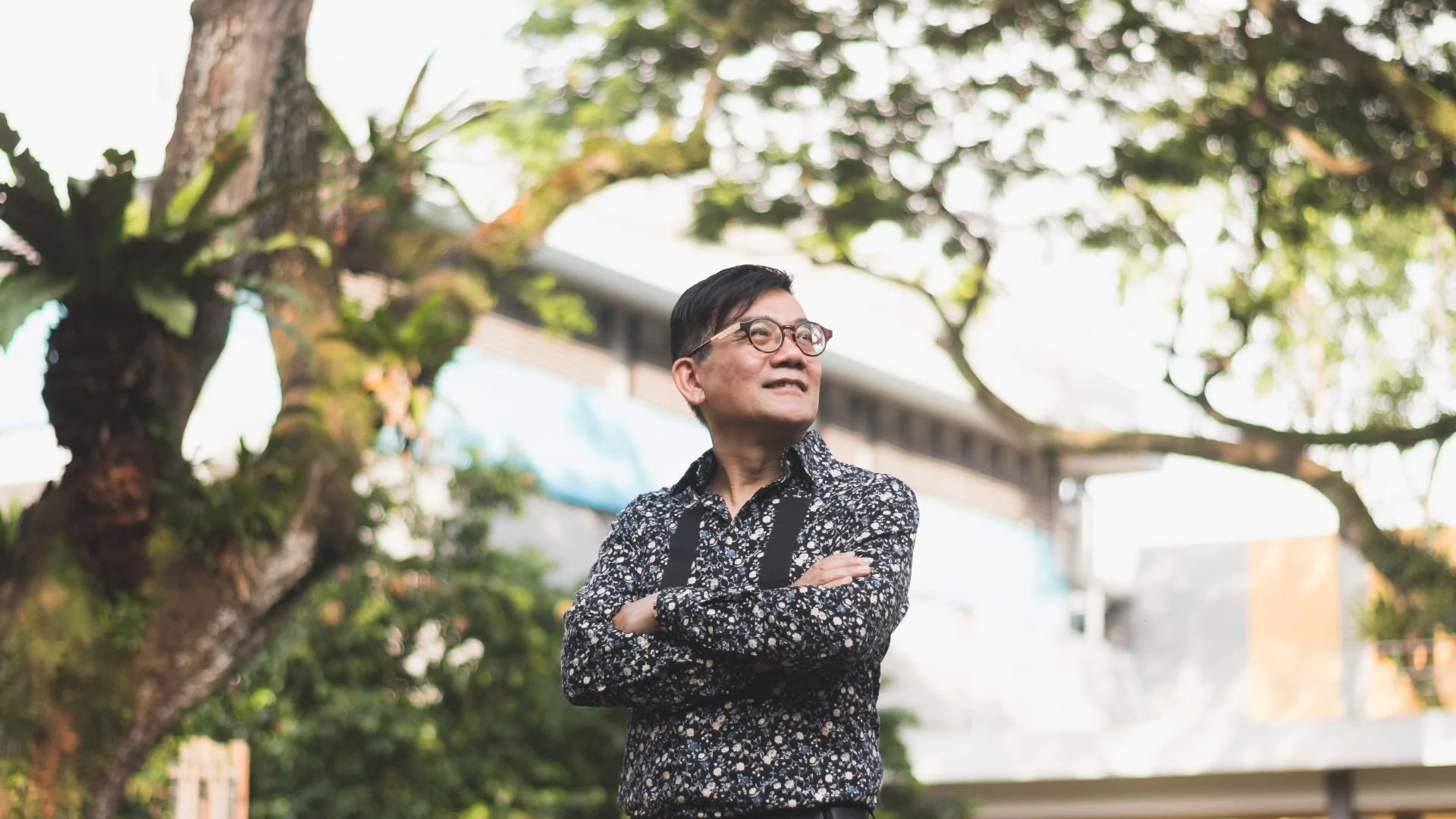
“However, we cannot force identity. We are currently the custodians of these buildings, but the next generation must decide what they identify with. I call this ‘conservation in motion’—it must adapt and keep up with the times.”
- Dr. Ho Puay Peng, NUS professor & UNESCO Chair on Architectural Heritage Conservation and Management in Asia
Dr. Ho Puay Peng
From my interview with Dr. Ho Puay Peng, a professor at the NUS Department of Architecture and the current UNESCO Chair on Architectural Heritage Conservation and Management in Asia, I had three major takeaways.
First, conservation encompasses both the tangible and the intangible. He noted that while it’s important to preserve historical sites that evoke nostalgia, it’s up to the current generation to assess their relevance to contemporary society. Therefore, if the current generation can’t relate to a historical site, it might be taken down while the intangible culture is preserved (e.g., the religious practices or cooking style of an ethnic group, exhibited in museums or preserved in oral histories). I found this comment highly valuable because it challenged the conventional criteria for evaluating heritage sites (which include historical significance, architectural or technical value, and authenticity). His new take introduced me to the concept of “conservation in motion,” in which sites are recognized for their social and cultural appropriateness to modern society.
Second, conservation efforts have to be both “top-down and bottom-up.” Especially in urbanizing countries like Singapore, the government has power over most decisions regarding landscape use. However, to achieve complete conservation, public efforts (e.g., sharing a personal story about a specific heritage site) are necessary to convey the community’s personal connections to heritage sites.
Third, heritage sites are valuable because of the personal significance and meaning they have acquired over time. Any object without a “behind-story” has no value; it’s the stories and personal connections that make the object necessary in one’s life, as the object is possibly the only way to rekindle those memories. Therefore, for the older generation, historical sites serve as both a time machine and a time capsule for future generations.
Based on these takeaways from my interview with Professor Ho, I encourage you to explore the historical sites in your local area. Why are they preserved? Do they hold inherent values or stories? How relevant are they to your contemporary life?
National University of Singapore
8 Architecture Drive, Singapore 117356
